Wednesday, March 30, 2011

The Twilight Garden: A Guide to Enjoying Your Garden in the Evening Hours

To show how easily we can have inviting nighttime gardens, Leendertz (gardening columnist, "Guardian, UK; Family Garden" highlights night-flowering plants, foliage that sparkles in soft lighting, and exotic scents and sounds that lure mysterious creatures. She explains the heightened importance of creating coziness and using intriguing silhouettes, whether in a front garden or a more private, contemplative one. Several party ideas are included, some with kid-friendly themes. The majority of the book is a plant directory, including color photos and USDA zone information for over 60 plants.
(Library Journal)
Request The Twilight Garden from the catalog.

Wednesday, March 16, 2011

Landscaping for Your Home

Homeowners looking for an encyclopedic beginner's guide to landscape design, installation, and maintenance will find it in this new how-to book by garden writer and photographer Erler (Design Ideas for Home Landscaping). Erler describes how even the most inexperienced homeowner can design and create a garden that complements a house's style. She offers practical tips on laying out and installing the bones of the space (walkways, decks, fences, and beds) and the finishing touches that turn a yard into a satisfying garden (fountains, lighting, furniture, and art). She takes no horticultural experience for granted and even offers a visual guide to distinguishing a shovel from a spade. The lists of horticultural tips, recommended plants, maintenance checklists, step by-step guidance, and more than 400 color photographs and drawings make this a comprehensive guide filled with valuable inspiration and instruction.
Request Landscaping for Your Home from the catalog.

Mini Farming: Self-Sufficiency on 1/4 Acre

Intensive growing methods can allow gardeners with small lots to offset seriously the yearly grocery bill. Markham has adapted, through years of experimentation, the techniques developed by such gardener-authors as Mel Bartholomew ("Square Foot Gardening") and John Jeavons ("How To Grow More Vegetables and Fruits"). In this revised and expanded version of his 2006 self-published book, now with almost double the text and with 250 color photographs, Markham suggests that a small family (with one outside income) can come out economically ahead by following his strategies, provided that their overhead is low and that they produce more calorie-dense foods in addition to vegetables and fruits. His instructions for projects show how to spend as little capital as possible in order to keep the operation economical, with plenty of references for more in-depth study. Although he does not cover wine and cheese making, there is plenty on soil minerals. VERDICT While not as hip as other recent books on urban homesteading, such as Carleen Madigan's "The Backyard Homestead" and Kelly Coyne and Erik Knutzen's "The Urban Homestead", this differs by focusing on practicality and the bottom line. A helpful addition, alongside Bartholomew and Jeavons, for the serious DIY gardener.Margaret Heller, Dominican Univ. Lib., River Forest, IL (Library Journal)
Request Mini Farming from the catalog

Monday, March 7, 2011

Mid-Atlantic Home Landscaping

This larger-format edition provides inspiring ideas for making the Mid-Atlantic home landscape more attractive and functional. Starting with the 200 best plants that thrive in the region, area landscape professionals created 46 outdoor design concepts that readers can work with. More than 430 color photographs and drawings complement the easy-to-follow instructions for caring for and installing plants, paths, patios, ponds, and arbors.
Request Mid-Atlantic Home Landscaping from the catalog.

Friday, February 25, 2011

Edible Landscaping

Since Rosalind Creasy popularized the concept of landscaping with edibles a quarter-century ago, interest in eating healthy, fresh, locally grown foods has swept across the nation. More and more Americans are looking to grow clean, delicious produce at home, saving money and natural resources at the same time. And food plants have been freed from the backyard, gracing the finest landscapes--even the White House grounds! Creasy's expertise on edibles and how to incorporate them in beautifully designed outdoor environments was first showcased in the original edition of Edible Landscaping (Sierra Club Books, 1982), hailed by gardeners everywhere as a groundbreaking classic. Now this highly anticipated new edition presents the latest design and how-to information in a glorious full-color format, featuring more than 300 inspiring photographs. Drawing on the author's decades of research and experience, the book presents everything you need to know to create an inviting home landscape that will yield mouthwatering vegetables, fruits, nuts, and berries. The comprehensive Encyclopedia of Edibles--a book in itself--provides horticultural information, culinary uses, sources, and recommended varieties; and appendices cover the basics of planting and maintenance and of controlling pests and diseases using organic and environmentally friendly practices.
Request Edible Landscaping from the catalog.

Tuesday, February 22, 2011

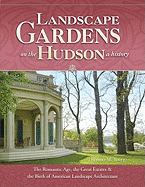
Landscape Gardens on the Hudson, a History

The designed historic landscapes of the Hudson River Valley : Hyde Park, Sunnyside, Olana, Clermont, Lyndhurst, Montgomery Place, Locust Grove, Wilderstein, Springside, Idlewild, Blithewood, Millbrook, Kenwood, The Point, Philipse Manor, Van Cortlandt Manor, The Pastures (Schuyler Mansion) and more.
Request Landscape Gardens of the Hudson River Valley from the catalog.

Homegrown Harvest: A Season-By-Season Guide to a Sustainable Kitchen Garden

Written by the American Horticultural Society's foremost fruit, vegetable and herb experts, "Homegrown Harvest" provides lifestyle-changing advice that gardeners need for growing a year-round supply of healthy edible crops for their table. Specific local and regional advice enables gardeners to decide how and what to grow wherever they live in North America.
The book starts with planning what to grow, then how to grow it- whether in an allotment, containers, a raised bed or vegetable patch- as well as information on how to get the best from your soil.
Next, over the course of 12 seasonal chapters, from early spring to late winter, the book shows how to go from sowing to harvesting with clear instructions that help you stay on top of the joys and challenges of a productive garden.
From apples and asparagus, raspberries to radishes, this book shows how to apply age-old techniques in a timely fashion, to get the most from your plot.
Request Homegrown Harvest from the catalog.